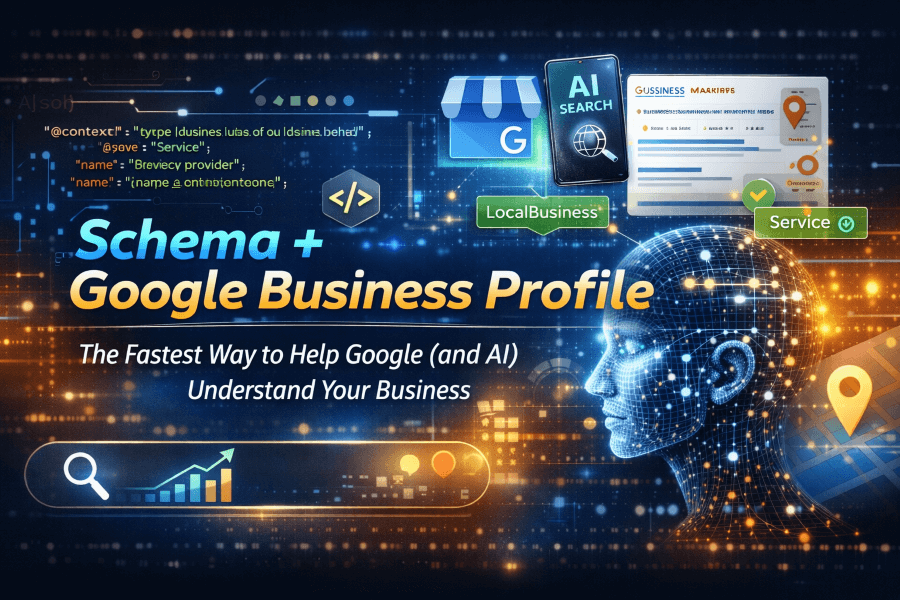
What’s The Fastest Way To Clarify Your Business Online?
The fastest way is to align your Google Business Profile with Schema Markup for Local SEO on your website.
This pairing reduces confusion for search engines and AI systems.
It also improves how your services, location, and trust signals display in search.
- GBP tells Google what you do and where you serve.
- Schema confirms the same facts in structured form.
- Together, they create cleaner entity signals and stronger local relevance.
FAQ: Schema + Google Business Profile

What is schema markup, in plain English?
Schema markup is structured data added to your website.
It helps search engines understand your business details faster.
Most teams use JSON-LD because it is easy to manage.
Does schema markup directly improve local rankings?
Schema is not a guaranteed ranking shortcut.
It improves understanding, consistency, and rich-result eligibility.
Those improvements often support better engagement and visibility over time.
Which schema types matter most for local businesses?
Start with LocalBusiness or Organization schema.
Then add Service schema for core offerings.
Add FAQ schema where you answer common customer questions.
How does schema work with Google Business Profile?
GBP supplies your listing data in Maps and local results.
Schema reinforces matching details on your website.
Matching signals help Google trust your “who, what, where.”
What details must match between my website and GBP?
Keep your name, address, and phone consistent.
Align your services, service areas, and business hours.
Use the same wording where it naturally fits.
Can schema help with AI-driven search experiences?
Schema provides clear, machine-readable context.
That clarity can reduce ambiguity for AI summaries.
It also improves the consistency of your online entity footprint.
What are common schema mistakes that hurt results?
Do not mark up information that is not visible on the page.
Avoid conflicting business addresses across pages.
Always validate your markup after publishing.
How long does it take to see results from schema updates?
Google can discover schema quickly after crawling.
Visible changes often take days or weeks.
Consistent updates usually compound with other local SEO work.
Why Schema Markup for Local SEO works so well with GBP
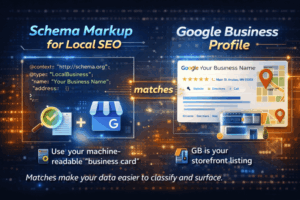
Schema Markup for Local SEO gives Google a clean, structured version of your business facts.
Your Google Business Profile gives Google a verified listing and engagement signals.
When both sources match, your business becomes easier to classify and surface.
Think of GBP as your storefront listing.
Think of schema as your machine-readable “business card.”
Together, they reduce mixed signals across the web.
The core goal: Remove ambiguity
Local search fails when your business details look inconsistent.
AI search fails when your services and locations look unclear.
Your job is to make your data boring and consistent.
- Use one canonical business name across your website and GBP.
- Use one primary phone number everywhere.
- Use the same service naming across pages and GBP services.
- Confirm hours and holiday hours in GBP.
What to implement first: A practical schema stack
Start with the basics before advanced markup.
This order keeps implementation clean and scalable.
- LocalBusiness schema on your primary location page.
- Service schema on each core service page.
- FAQ schema on pages that answer real questions.
- Organization schema when you need broader brand identifiers.
Only mark up what the page clearly states.
Google expects your structured data to match the visible content.
GBP optimization that supports your schema
GBP performance improves when your profile is complete and current.
Focus on relevance signals first.
Then improve prominence and engagement signals.
- Choose the best primary category for your main service.
- Add secondary categories only when they truly apply.
- List services that match your website service pages.
- Upload real photos that reflect your work and team.
- Answer common questions with clear, short responses.
Why a full-service marketing team makes this faster
Schema and GBP touch content, web development, and strategy.
A full-service team connects these parts without delays.
That reduces rework and speeds execution.
Integrated teams also prevent “departmental drift.”
Your SEO, content, and web changes stay aligned.
That alignment improves consistency across channels.
Two credible sources on integrated marketing value
McKinsey describes how cross-functional marketing teams improve accountability and ways of working.
Read their perspective here:
McKinsey on modern marketing operating models.
Johnson & Wales University explains how integrated marketing reduces wasted effort and improves efficiency.
Read more here:
What integrated marketing is and why it works.
How VantagePoint can help

VantagePoint Marketing Group supports local businesses in Anoka and the surrounding area.
We build systems that make Google and AI understand your business faster.
- Explore our full marketing services
- Read more marketing insights on our blog
- Contact our team for a local SEO and schema plan
If you want quick wins, start with GBP and baseline schema.
If you want compounding results, build service pages and supporting FAQs.