The Hybrid Strategy: How to Combine Organic Content and Paid Ads
This guide shows how to combine organic and paid marketing for faster growth and lower blended CAC. You will learn orchestration tactics, shared KPIs, AI-era attribution, and budget models that help teams move from channel silos to one unified growth engine.
Why Combine Organic and Paid Marketing in 2026?
Search, social, and marketplaces now surface AI-generated answers. Creative velocity and bidding automation are rising. Teams that orchestrate owned and paid together capture compounding demand while exploiting near-term intent.
Operating Model: One Strategy, Two Speeds
Entity-first content, technical SEO/AEO, reviews, community, and email. Builds durable trust and lowers future CAC.
Search, social, retail, and programmatic. Validates offers quickly and scales winning angles with precision.
Decision Framework: From Hypothesis to System
- Hypothesize demand pockets via query mining, site search, and CRM notes.
- Test fast with paid variants and tight conversion tracking.
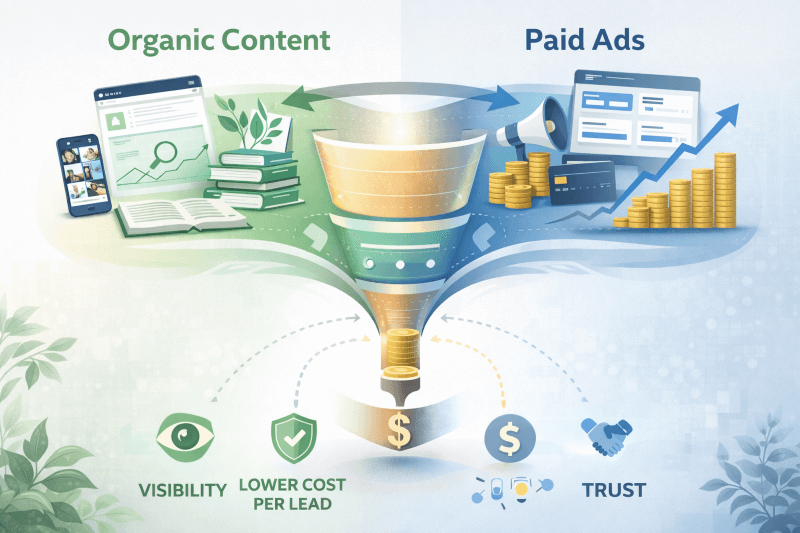
- Promote winners into evergreen pages, FAQs, and email flows.
- Retarget with proof, calculators, and demos, not just discounts.
- Close the loop by feeding first-party segments back into bidding.
“Lite Infographic”: The Signal-Sharing Loop
Budgeting in Practice
| Scenario | Recommended Mix | Notes |
|---|---|---|
| New offer, short runway | 40% organic / 60% paid | Use paid for speed; hard-promote winners into evergreen content. |
| Local service with reviews | 70% organic / 30% paid | Leverage GBP, entities, and FAQs; pulse paid for peak season. |
| Ecommerce with promos | 50% organic / 50% paid | Layer promo calendars over evergreen SEO; protect margins. |
Shared KPIs That Align Teams
- North star: blended CAC and pipeline or revenue per marketing hour.
- Leading indicators: qualified sessions, engaged views, save/share rate.
- Conversion: form submits, calls, carts, demos, and assisted conversions.
AI-Era Tactics to Combine Organic and Paid Marketing
- AEO/GEO readiness: Structure entities, FAQs, and citations for answer engines.
- Creative iteration: Generate variants with AI; enforce brand voice with human QA.
- Smart bidding + first-party data: Sync segments, LTV signals, and churn scores.
- Narrative analytics: Weekly auto-summaries that highlight anomalies and wins.
Attribution Without the Noise
Revenue ÷ total cost; cohort LTV vs CAC trends.
Geo holdouts, pre/post tests, and PSA controls for branded terms.
Simple regressions that respect seasonality and promo effects.
Proof from the Field
5-Star GBP Review — Erica:
“Vantage Point team members! You ROCK! You went above and beyond for our company. Your ideas, opinions, options and overall knowledge was amazing. We cannot thank you enough. Thank you! -Cast Yer Bait Custom Rod & Tackle!!”
Sources to Track
- Search Engine Journal — AI search and organic developments.
- Think with Google — ads insights and consumer trends.
- HubSpot Research — marketing benchmarks and adoption data.
Work with VantagePoint
We design unified growth systems that fuse owned content, AI-assisted creative, and efficient media buying. Explore our Services, browse the latest on our Post page, or Contact us to build a combined plan.
FAQs: Combine Organic and Paid Marketing
- How do I split budget without starving one channel?
- Use an objective-based mix. Fund always-on organic and set paid sprints for validation and scale.
- What is the fastest way to align teams?
- Adopt shared KPIs, a weekly creative sync, and a documented loop for signal sharing.
- How does combining channels lower CAC?
- Organic improves relevance and quality scores. Paid testing uncovers high-intent angles faster.
- How should I measure impact in the AI era?
- Blend CAC, cohort LTV, and incrementality tests. Avoid single-touch attribution models.
- What content should move from paid to owned?
- Winning hooks, objections, and proof that convert in paid should become evergreen pages and FAQs.
Need a combined growth plan?
Contact VantagePoint • Services • All Posts

Published January 2026 — Authored by Jacqueline McGreevey