
How Google Ranks Websites
What You’ll Learn in This Article
This article explains the most important Google website ranking factors and how they impact your visibility in search results. You’ll learn what Google looks for in high-ranking websites, including content quality, mobile-friendliness, site speed, and backlinks. You’ll also get actionable tips to improve your rankings, drive more traffic, and build online authority.
For more digital marketing strategies, check out our blog post archive or view our full-service offerings.
What Are Google Website Ranking Factors?
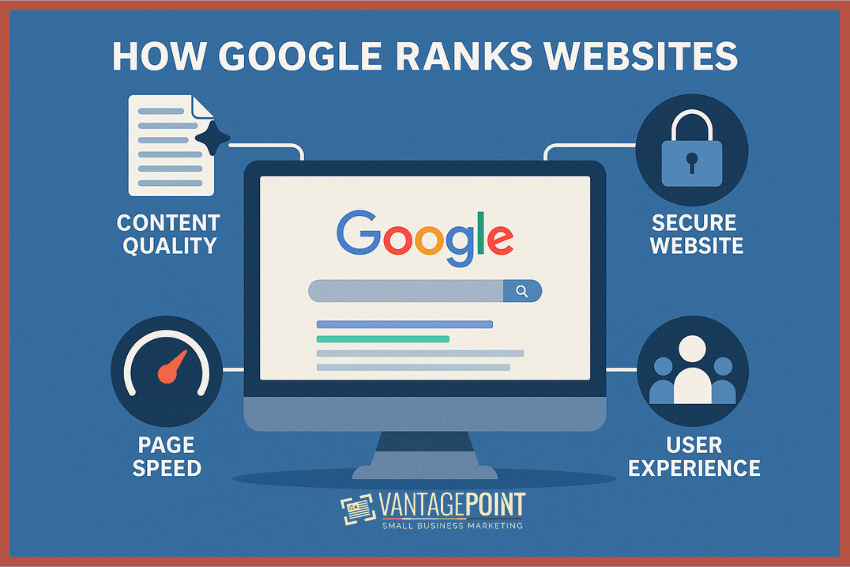
Google uses over 200 ranking signals to determine which websites appear first in search results. These are known as Google website ranking factors. While Google doesn’t reveal every factor, experts agree on several key elements that consistently influence rankings.
According to Search Engine Journal, these factors include content quality, user experience, backlinks, mobile optimization, and technical SEO elements like page speed.
⭐️⭐️⭐️⭐️⭐️ 5-Star Review
“VantagePoint Marketing has been instrumental in improving our search rankings. Their expertise helped us reach more local customers than ever before!” — Happy Client
Top Google Website Ranking Factors You Need to Know
Understanding and optimizing these ranking factors can significantly improve your website’s visibility and search performance.
1. High-Quality, Relevant Content
Content is king. Google prioritizes pages that provide original, helpful, and well-structured information that meets user intent.
2. Mobile-Friendliness
Websites must perform well on mobile devices. Google uses mobile-first indexing, meaning it primarily evaluates your mobile content for ranking.
3. Website Speed and Performance
Slow-loading sites lose rankings. Optimize images, enable caching, and improve server response times to enhance performance.
4. Backlinks and Domain Authority
Backlinks from credible websites boost your authority. The more high-quality links you earn, the better your chances of ranking higher.
5. Secure and Accessible Website (HTTPS)
Google favors secure websites. Ensure your site uses HTTPS and is accessible to both users and search engine crawlers.
6. User Experience (UX) Signals
Metrics like bounce rate, time on site, and click-through rate indicate content relevance and usability. Google uses these to evaluate user satisfaction.
Learn more about user experience optimization from Neil Patel’s UX SEO Guide.

How to Improve Your Website’s Ranking
Implement these best practices to boost your rankings and reach more customers:
- Regularly update your website with fresh, high-value content.
- Ensure your site is mobile-friendly and responsive.
- Optimize page speed by compressing images and reducing scripts.
- Build credible backlinks from industry-relevant websites.
- Use descriptive meta tags and headings with target keywords.
- Ensure your website uses HTTPS for security.
Need expert help optimizing your website? Contact VantagePoint Marketing Group today.
Why Google Website Ranking Factors Matter
Understanding Google website ranking factors is the key to improving your online visibility, traffic, and authority. By focusing on content quality, mobile optimization, speed, and user experience, you position your business for long-term success in search rankings.
Ready to elevate your SEO strategy? Explore our services or reach out through our contact form to get started.
Stay updated with more SEO and digital marketing tips by visiting the VantagePoint Marketing Blog.
 Published by VantagePoint Marketing Group | May 2025
Jacqueline McGreevey