Why Isn’t Your Small Business Marketing Generating More Leads?
Why Small Business Lead Generation Falls Short
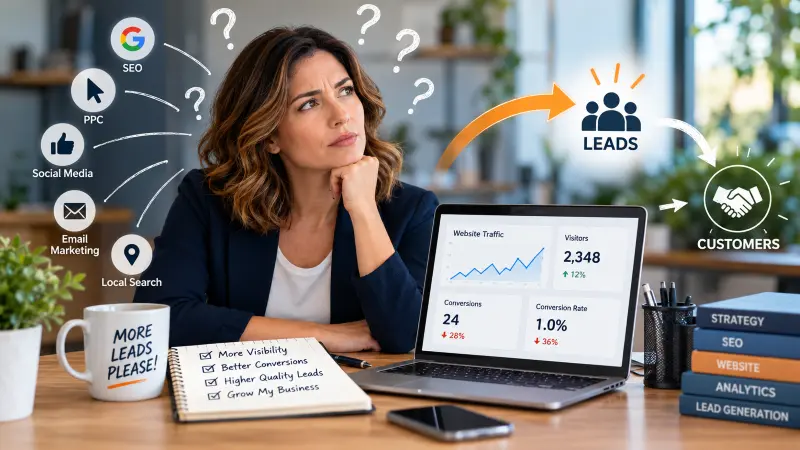
Small business lead generation often falls short because marketing efforts fail to connect visibility, customer trust, and conversion opportunities. Your business might attract website visitors without convincing them to contact you. Other businesses struggle because their marketing reaches the wrong audience or lacks effective tracking. Improving results requires identifying where potential customers lose interest and removing those barriers.
At VantagePoint Marketing, we help businesses connect their marketing activities to measurable goals. Successful marketing isn’t simply about attracting attention. It’s about helping the right customers find your business, understand its value, and take action.
What Are the Most Common Reasons Small Businesses Aren’t Generating Leads?
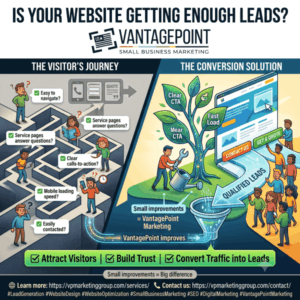
Many businesses invest in websites, SEO, social media, and advertising without seeing consistent inquiries. Often, the problem isn’t one marketing channel. It’s a disconnect between several parts of the customer journey. Here are six common obstacles that can limit lead generation.
1. Your Marketing Attracts the Wrong Audience
More website traffic doesn’t automatically mean more customers. Visitors must have a genuine interest in your products or services. For example, a remodeling contractor might attract visitors researching DIY home repairs. Those visitors may never intend to hire a professional. Effective search engine optimization focuses on search intent, customer needs, and service relevance. Ask yourself whether your marketing attracts people researching a topic or actively searching for your services. Both audiences have value, but they require different messaging.
2. Your Website Doesn’t Clearly Explain Your Value
Visitors should quickly understand what your business offers, whom you serve, and why they should choose you. Confusing headlines, complicated navigation, and generic messaging can discourage inquiries. Strong website design combines clear messaging with convenient navigation and visible contact opportunities.
Every important service page should answer three questions:
- Does this business provide what I need?
- Can I trust this company to solve my problem?
- What should I do next?
If visitors cannot answer these questions, they may continue searching elsewhere.
3. Your Calls to Action Don’t Encourage Visitors to Respond
A call to action (CTA) tells visitors what to do next. However, generic buttons such as “Learn More” aren’t always persuasive.
Consider matching your CTA to the visitor’s immediate needs.
- Request a Free Website Assessment
- Schedule a Marketing Consultation
- Get an Estimate for Your Project
- Talk With a Local Marketing Specialist
These examples explain what visitors can expect after clicking. Effective CTAs should appear naturally throughout important pages. Avoid overwhelming visitors with too many competing options.
4. Your Marketing Channels Aren’t Working Together
Small business lead generation often involves several touchpoints before someone contacts a company. A potential customer might discover your business through Google, review your website, and examine your Google Business Profile. They might return days later after seeing a social media post or advertisement. When these channels communicate inconsistent messages, potential customers may lose confidence. A coordinated marketing strategy connects your website, search presence, advertising, and branding around common goals. Consistency helps customers recognize your business and understand what makes it valuable.
5. Your Business Isn’t Building Enough Trust
Customers often compare several businesses before making contact. They want evidence that your company can deliver reliable results. Your website should provide meaningful reasons to trust your business.
- Authentic customer reviews and testimonials
- Examples of completed projects or client results
- Information about your team’s experience
- Clear service descriptions and service areas
- Professional photographs and consistent branding
- Accessible contact information
Trust signals should support actual claims rather than rely on broad promises. For example, a specific project description explains your expertise more effectively than simply claiming exceptional service.
6. You’re Measuring Traffic Instead of Business Results
Website visits, impressions, and social engagement provide useful information. However, they don’t reveal whether your marketing produces qualified customers. Businesses should also track meaningful actions, including contact forms, phone inquiries, appointments, estimates, and completed sales. Google Analytics recommends tracking key events that represent important business interactions. Reviewing these actions helps businesses understand what visitors do after arriving on their websites. VantagePoint’s marketing analytics and measurement services help connect performance data to actionable business decisions.
How Can You Identify Where Your Business Is Losing Potential Leads?
Before increasing advertising spending, determine where the customer journey begins to break down. A simple diagnostic approach examines four stages of lead generation.
| Customer Journey Stage | Potential Problem | Recommended Improvement |
|---|---|---|
| Discovery | Few relevant visitors find your business. | Improve SEO, local visibility, and audience targeting. |
| Engagement | Visitors leave without exploring services. | Improve messaging, navigation, and content relevance. |
| Conversion | Interested visitors don’t submit inquiries. | Review CTAs, contact forms, mobile usability, and trust signals. |
| Follow-Up | Inquiries don’t become paying customers. | Review response times, lead qualification, and sales processes. |
Each stage requires different improvements. Adding advertising won’t necessarily fix a confusing website or ineffective follow-up process. Identifying the weakest stage helps businesses invest resources where they can make the greatest difference.
Why Does Small Business Lead Generation Require More Than Website Traffic?
Traffic represents opportunity, not guaranteed revenue. A visitor only becomes a lead after expressing potential interest in your business. Even then, not every lead is qualified or ready to purchase. Consider two hypothetical businesses.
Business A: Receives 2,000 monthly website visits and generates 20 inquiries.
Business B: Receives 800 monthly website visits and generates 32 inquiries.
Business A has a 1% visitor-to-inquiry rate. Business B has a 4% rate. Although Business B attracts fewer visitors, its website produces more inquiries. These hypothetical results demonstrate why traffic alone cannot measure marketing effectiveness. Businesses must also evaluate inquiry quality, customer acquisition, and revenue.
How Can Conversion Rate Optimization Improve Lead Generation?
Conversion Rate Optimization (CRO) improves the percentage of visitors completing meaningful actions. It focuses on helping existing traffic become more valuable rather than relying exclusively on additional visitors.
Potential improvements include:
- Simplifying contact forms
- Improving mobile navigation
- Making phone numbers easier to find
- Adding relevant testimonials near important CTAs
- Clarifying service descriptions
- Improving page speed and usability
- Testing different headlines and CTA messaging
For example, a contractor might replace a generic “Contact Us” button with “Request a Free Project Estimate.” That wording clarifies the next step and better matches a prospective customer’s immediate goal. However, businesses should evaluate changes using actual visitor behavior and conversion data. Related cluster article: Getting Website Traffic but Not Enough Leads? (November 2026)
Which Marketing Metrics Actually Matter for Lead Generation?

The most valuable marketing metrics depend on your business goals. However, several measurements provide particularly useful insights.
Qualified Leads
A qualified lead represents someone whose needs, location, and purchasing intent align with your business. Thirty qualified inquiries may provide more value than 100 unrelated submissions.
Visitor-to-Lead Conversion Rate
This metric measures how frequently website visitors become leads. Divide the number of attributed leads by website visitors, then multiply by 100. For consistent reporting, define exactly which inquiries and visitors you’re including.
Cost Per Qualified Lead
This measures how much marketing spending generates each qualified inquiry. Divide relevant marketing costs by the number of qualified leads generated during the same period.
Lead-to-Customer Conversion Rate
This measures how successfully qualified leads become paying customers. It also helps identify possible weaknesses in sales follow-up or customer communication.
Customer Acquisition Cost
Customer acquisition cost compares the expenses of acquiring customers against the number of new customers gained. It provides a broader perspective than website traffic or inquiry counts alone. Related cluster article: Which Marketing Channels Are Actually Bringing You Customers? (November 2026)
How Should Small Businesses Prioritize Marketing Improvements?
Improving every marketing channel simultaneously can become expensive and difficult to measure. Instead, identify which issue creates the greatest obstacle to growth.
Start with these questions:
- Are potential customers finding our business?
- Does our website clearly explain our services?
- Can visitors contact us without unnecessary steps?
- Do we know which channels generate qualified leads?
- Are inquiries receiving timely, effective follow-up?
Address fundamental usability and tracking problems before expanding complicated campaigns. For example, a business with strong search visibility but limited inquiries should investigate website performance. A business receiving very few relevant visitors may need stronger search visibility or more targeted advertising. These situations require different solutions and different investments.
Related cluster article: Is Your Marketing Underperforming? Here’s Where to Start. (November 2026)
Does AI Search Change How Businesses Generate Leads?
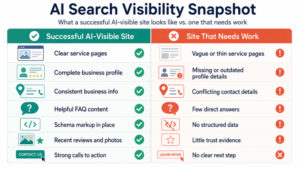
AI-powered search experiences are changing how people discover businesses and research their options. However, appearing in an AI-generated answer doesn’t guarantee a website visit or customer inquiry. Businesses still need accurate service information, credible content, clear branding, and effective conversion opportunities. A visitor who arrives through traditional search or an AI-assisted discovery process still needs confidence before contacting you. VantagePoint combines SEO, answer engine optimization, and generative engine optimization with broader marketing strategies. The objective is not simply greater visibility. It’s helping relevant customers move from discovery toward meaningful engagement.
Frequently Asked Questions About Small Business Lead Generation

Why is my small business getting website visits but no leads?
Your visitors may not need your services, or your website may lack clear messaging and effective calls to action. Review search intent, usability, contact forms, and trust signals. Website analytics can help identify where visitors lose interest.
How long does it take to improve small business lead generation?
Results depend on your existing traffic, competition, website condition, and marketing channels. Website improvements may affect inquiries sooner than organic search strategies. SEO and content development generally require sustained effort and ongoing measurement.
Should I invest in SEO or paid advertising to generate more leads?
Both can support lead generation, but they serve different purposes. Paid advertising can create immediate opportunities for targeted visibility. SEO develops organic search visibility over time. Your goals, budget, competition, and website performance should guide the decision.
What is a good website conversion rate for a small business?
There isn’t one reliable conversion rate for every business. Results vary by industry, traffic source, offer, and conversion definition. Compare performance against your own historical data and evaluate whether inquiries become qualified customers.
Can better lead tracking help reduce wasted marketing spending?
Yes. Lead tracking can reveal which campaigns generate relevant inquiries and which produce little business value. Connecting lead sources with customer outcomes helps businesses adjust spending and improve their marketing decisions.
Turn Your Marketing Efforts Into Meaningful Business Opportunities
Successful small business lead generation requires more than advertising, website traffic, or frequent social media posts. Your marketing should guide prospective customers through a connected experience, from initial discovery to confident decision-making. That means attracting relevant audiences, communicating your value, removing conversion barriers, and measuring meaningful results. At VantagePoint Marketing, we help small businesses identify marketing weaknesses and create practical strategies for improvement. Our team combines website design, SEO, AI search optimization, digital advertising, analytics, and marketing strategy to support measurable business growth.
Not sure why your marketing isn’t generating enough leads?
Start with a free website and online presence assessment. We’ll help you identify opportunities to improve visibility, customer engagement, and lead generation.
Contact VantagePoint Marketing to Request Your Free Assessment
Call 612-444-2211 or email admin@vpointusa.com.

Published November 2026
Authored by Jacqueline McGreevey, Digital Content & SEO Strategy Manager, VantagePoint Marketing.