
What Makes Website Content Worth Citing or Recommending?
Authoritative website content gives people and search systems a reason to trust, use, and reference it. Strong content adds original insight, demonstrates real experience, answers questions completely, identifies its sources, and makes expertise easy to verify. Useful structure, current information, supporting evidence, and clear authorship can further strengthen its value. Publishing content is easy. Publishing something people want to save, share, reference, or recommend requires much more thought. The difference usually comes from usefulness, specificity, credibility, and genuine experience. This distinction matters as search continues evolving. Google Search, AI Overviews, AI Mode, and other discovery tools can draw from many competing sources. Businesses need to provide information that contributes something useful rather than simply repeating what already exists.
Frequently Asked Questions About Authoritative Website Content

What makes website content authoritative?
Authoritative content demonstrates knowledge through accurate information, useful detail, experience, evidence, and clear sourcing. It should help readers understand a subject better or make a more informed decision.
Does longer content have more authority?
No. Google does not recommend a preferred word count. Content should be long enough to answer the topic thoroughly without adding unnecessary information.
Does an author bio help website content?
Clear authorship helps readers understand who created the content and why that person has relevant knowledge. Google also recommends providing author information when readers would reasonably expect it.
Should businesses cite outside sources in blog articles?
Yes, when outside evidence strengthens the content. Credible external links can help readers verify facts and explore important information in greater depth.
Can AI-generated content become authoritative?
AI can assist with research, organization, and drafting. However, businesses should add real expertise, verify facts, provide original value, and review content before publishing.
What makes content more useful for AI search?
Clear answers, original insights, logical structure, strong sourcing, and useful supporting details can improve content quality. These qualities also make information easier for people to understand and evaluate.
Why Some Content Becomes a Source and Other Content Does Not
Imagine ten websites answering the same customer question. Eight provide nearly identical definitions and basic tips. One explains the topic using real examples, useful comparisons, supporting evidence, and experience. That final article gives the reader something different. It may clarify a difficult decision or answer questions the other pages overlooked. Those differences can make content considerably more valuable. Google now describes valuable content for generative search as unique and “non-commodity.” It specifically encourages businesses to contribute information based on real knowledge and experience. Review Google’s guidance for generative AI features in Google Search for additional information.
Authoritative Website Content Adds Something the Internet Did Not Already Have
The easiest content to create is often the least distinctive. Anyone can summarize five common tips from existing search results. That approach rarely demonstrates why your business deserves attention. Strong content adds something specific. It may offer first-hand observations, original photographs, project lessons, regional expertise, comparisons, data, or expert explanations. Even a familiar topic can become valuable when the business contributes its own knowledge. Before publishing, ask one question: What will someone learn here that they could not get from a generic summary? If the answer is unclear, the page probably needs more work.
Seven Qualities That Make Content More Worth Citing
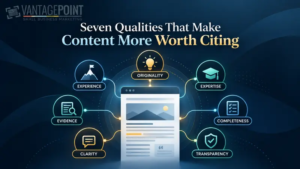
| Content Quality | What It Adds | Example |
|---|---|---|
| Originality | Information beyond common summaries | Project lessons, observations, or original research |
| Experience | Evidence that someone understands the subject firsthand | Examples from actual client or field work |
| Expertise | Deeper explanation of complex topics | Professional review or technical commentary |
| Evidence | Support for important claims | Government, industry, research, or primary sources |
| Completeness | Enough information to satisfy the reader | Benefits, limitations, examples, and next steps |
| Clarity | Information that is easy to understand | Headings, tables, lists, images, and direct answers |
| Transparency | Context about who created the information | Author pages, expert review, sources, and update dates |
1. First-Hand Experience Creates Information Others Cannot Easily Duplicate
Experience is one of the strongest ways a business can differentiate its content. Your team sees customer questions, project challenges, unexpected problems, and successful solutions every day. Those experiences contain information competitors may not have. A remodeling contractor can explain what crews actually find behind aging Minnesota siding. An arborist can describe local tree problems after heavy snow. A marketer can explain patterns found while reviewing real Search Console data. These examples demonstrate knowledge instead of merely claiming expertise. They also make content more specific and useful for potential customers.
2. Expert Input Can Turn Basic Information Into Useful Insight
Some topics benefit from professional review. The writer may organize and explain the information, while a subject expert verifies technical details. That process can improve accuracy and add useful insight. Expert involvement becomes especially valuable when an article discusses construction, finance, legal issues, health, or complex technical subjects. Even lower-risk topics can benefit from knowledgeable review. The expert may notice details that a general writer would miss. This is one reason VantagePoint is beginning to distinguish between the article author and the subject expert. The author can create the resource while the business owner adds professional knowledge.
3. Clear Authorship Helps Readers Evaluate the Source
Readers should not have to wonder who wrote an important article. An author name gives the content human context. An author page can then explain relevant background, experience, and qualifications. Google’s people-first content guidance specifically encourages clear information about who created the content. Google also recommends linking authors within Article structured data to pages containing more author information. That does not mean every article needs an impressive list of credentials. It means the website should make content responsibility transparent.
At VantagePoint, articles can link to the Jacqueline McGreevey author page when appropriate. Client content can also identify an expert reviewer when that adds meaningful context.
4. Strong Sources Make Important Claims Easier to Trust

A business should not expect readers to accept every factual claim without support. Reliable sources show where important information originated. They also allow readers to investigate the subject further. Primary sources usually provide the strongest support. Examples include government agencies, manufacturers, professional organizations, research institutions, and official documentation. Secondary sources can also help when they provide credible analysis. Google itself recommends using external links when they provide useful context. Its link guidance notes that citing sources can help establish trustworthiness.
See Google’s link best practices for more information.
5. Specific Details Are More Useful Than Broad Claims
Generic statements rarely make content memorable. “Good drainage protects your property” may be accurate, but it tells readers very little. Specific information makes the idea more useful. A stronger article could explain where water commonly collects and what visible warning signs appear first. It could discuss grading, downspouts, soil conditions, or freeze-thaw concerns. Those details help readers understand what to look for. The same principle applies to almost every industry. Specificity signals that the writer understands the topic beyond its basic definition.
6. Good Content Answers the Next Question Too
A useful article should answer the initial question. Exceptional content often anticipates what the reader will ask next. This creates greater depth without adding unrelated material. Someone asking whether they can replace windows during winter may next ask about installation temperature or temporary heat loss. A complete article can address those concerns. The reader may then avoid another search entirely. Google’s helpful-content guidance asks whether readers leave feeling they learned enough to achieve their goal. That is a useful standard for business content as well.
7. Balanced Content Builds More Trust Than Sales Copy
Credible content does not pretend every solution is right for every customer. Sometimes a service has limitations, tradeoffs, or situations where another option makes more sense. Explaining those differences can build trust. A contractor comparing materials should discuss meaningful advantages and disadvantages. A marketing agency should explain when a tactic may not fit a business. Useful content helps someone make a decision instead of forcing a predetermined conclusion. This approach can also improve lead quality. Educated prospects often arrive with more realistic expectations.
8. Data Becomes More Valuable When You Explain What It Means

Numbers can strengthen an article, but statistics alone do not create authority. Readers need context. Explain why the data matters and how it relates to their decision. Businesses can also use their own aggregated observations when appropriate. Search trends, common customer questions, seasonal demand, or frequently requested services may reveal useful patterns. Avoid exposing confidential customer information. The value comes from interpretation. A chart becomes more useful when an expert explains what readers should notice.
9. Original Images Can Demonstrate Real Experience
Photos and graphics can provide evidence that written claims cannot. Project photographs demonstrate actual work. Diagrams can explain complex processes more clearly than text alone. Original images can also distinguish a business from competitors using the same stock photography. Google notes that relevant images and videos create additional opportunities for visibility within generative search experiences. Images should still support the topic. Decorative graphics should not replace useful information or clear written explanations.
10. Content Structure Affects How Useful the Information Feels

A great answer can become difficult to use when buried inside a wall of text. Readers need clear headings and logical sections. Tables, lists, and visual examples can simplify complicated information. Direct answers should appear where readers expect them. Supporting explanations can follow. This structure serves traditional search users, voice-style queries, and conversational search behavior. Google also recommends organizing content with paragraphs, sections, and meaningful headings. Good organization benefits people first and makes information easier to process.
11. Internal Links Add Context and Build Topic Depth
Authoritative content rarely exists in isolation. One article may introduce a subject while another explains one part in greater detail. Internal links help readers move naturally between those resources. They also help Google understand relationships among pages. Descriptive anchor text provides context about the destination page. Every important page should have links from other relevant pages. This strategy supports the pillar-and-cluster structure VantagePoint uses for deeper topics. Each page serves a purpose while contributing to a larger subject.
12. Updated Content Should Become Better, Not Just Newer
Old content does not automatically become poor content. Some topics stay accurate for years. Others change frequently and require ongoing review. Updating a page should involve more than changing the publication date. Review facts, links, examples, screenshots, regulations, products, and recommendations. Add useful information when new developments change the topic. Google specifically warns against changing dates simply to make content appear fresh. A meaningful update should improve the resource itself.
What Does Not Make Content Authoritative?
Several common practices can make a website look busy without creating much value. Businesses should be especially cautious about publishing large amounts of nearly identical content. Quantity does not automatically create expertise.
- Repeating information already available on dozens of websites
- Adding unnecessary words only to make an article longer
- Publishing claims without checking their accuracy
- Using statistics without identifying the source
- Creating location pages that only replace the city name
- Generating dozens of articles without expert review
- Writing solely around keywords instead of customer questions
- Changing publication dates without improving the content
- Using vague claims such as “best” without supporting evidence
Google does not have a preferred article length. It also warns against mass production and content created primarily to attract search traffic. Quality comes from usefulness rather than a target word count.
AI Changes the Value of Generic Content

Generative AI can summarize commonly available information extremely quickly. That changes the value of basic informational content. Businesses gain little advantage by publishing information that anyone can generate instantly. The opportunity lies in what AI cannot automatically know about your company. Your projects, customers, processes, opinions, regional experience, data, photographs, and professional judgment can add meaningful differentiation. This does not mean businesses should avoid AI tools. AI can help organize research, analyze information, and improve workflows. Human knowledge should still shape the final resource.
A Simple Content Authority Test
Before publishing a new page, review it from the reader’s perspective. These questions can expose weak areas before publication. They can also guide meaningful updates to older pages.
| Ask This Question | Strong Content Usually Says |
|---|---|
| Does this add anything original? | Yes, through experience, examples, analysis, or unique detail |
| Who created or reviewed it? | A clearly identified person with relevant knowledge |
| Can important claims be verified? | Sources, evidence, examples, or documentation support them |
| Does it answer the whole question? | The reader should not need another search for basic information |
| Is it easy to understand? | Clear headings, short sections, examples, tables, or visuals help |
| Would we recommend this to a customer? | The page provides genuine value beyond marketing language |
Authoritative Content Should Help Before It Sells
Businesses naturally want website content to generate leads. However, every paragraph does not need to sell. The strongest educational content often earns attention by helping first. A useful article can answer a question, solve a small problem, or clarify a decision. That positive experience can introduce the business more effectively than aggressive sales language. Expertise becomes part of the marketing. When readers repeatedly find helpful information on one website, the business becomes a more familiar resource. That relationship can support both visibility and conversions over time.
Build Content People and Search Systems Can Trust
Authoritative website content does not come from inserting more keywords or publishing more frequently. It comes from adding value people can recognize. Original experience, expertise, evidence, clarity, and transparency all contribute. Search technology will continue changing. Useful information remains valuable across those changes. Businesses that document what they genuinely know can build stronger long-term digital assets. VantagePoint Marketing helps businesses develop stronger SEO strategies, website content, AI visibility, and connected topic structures. We focus on creating information that serves customers while strengthening online authority.
If your website contains plenty of content but lacks meaningful visibility, the problem may be quality, structure, or strategy. Contact VantagePoint Marketing to discuss your website, search presence, and content opportunities.

Published October 2026
Authored by Jacqueline McGreevey










Trackbacks & Pingbacks
[…] A website should not make customers search for basic answers. Your primary services should appear clearly within navigation, service pages, headings, and page copy. Location information should also make sense for businesses serving defined communities. This clarity helps search systems connect your company with relevant topics. It also reduces ambiguity between similar businesses or services. A vague homepage cannot carry the entire SEO strategy. For example, a remodeling company may provide roofing, siding, windows, decks, and commercial work. Each major service deserves enough information for customers and search systems to understand it. Combining every service into one short paragraph creates very little context. Click here, for more information on making your website content worth citing […]
Comments are closed.